
Validation of an automated PVA detection algorithm
Rietveld TP, Rietveld PJ, Balakirev A, van der Ster BJP, Gommers D, Damiani LF, Smits F, van der Velde-Quist F, Endeman H, Snoep JWM, van Gent JO, van Oosten JP, Francovich JE, Goedendorp NG, Schoe A, Jonkman AH. Validation of an automated patient-ventilator asynchrony detection algorithm. ERJ Open Research. 2026;12(suppl 17):44.
- Type
- Conference abstract (ERS Respiratory Failure and Mechanical Ventilation, RFMV 2026)
- Venue
- ERJ Open Research, volume 12, supplement 17, abstract 44
- Published
- 4 March 2026
- DOI
- 10.1183/23120541.rfmv-2026.44
- Publisher
- ERS / ERJ Open Research
- Deep Breath authors
- Anton Balakirev — Deep Breath B.V., Rotterdam
What this abstract is
A validation of an AI-based algorithm, named Deep Breath in the abstract, that detects multiple patient–ventilator asynchrony (PVA) types in real time: ineffective effort, reverse, double, and delayed triggering, and premature and delayed cycling.
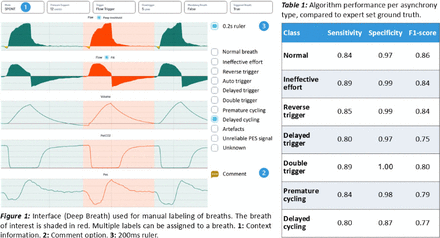
Ventilator and esophageal-pressure (Pes) waveforms were collected from 24 ventilated patients. 5,169 breaths were labelled for PVA by three clinicians from a pool of twelve. Ground truth was majority vote or consensus. The algorithm classified the same breaths using only ventilator waveforms (no Pes).
Validation criteria were at least 0.95 specificity on normal breaths and at least 0.8 recall per PVA type. The authors reported macro recall 0.83, specificity 0.96, and F1-score 0.81. Minimum PVA recall was 0.8 (delayed triggering); normal-breath specificity was 0.97. Both met the pre-set criteria.
This is a conference abstract in an ERJ Open Research supplement, not a full original article. It is research evidence for PVA classification. It is not MDR or FDA clearance of a bedside decision-support product.
Deep Breath note
The abstract names Deep Breath as the algorithm validated for real-time detection of multiple PVA types on ventilator waveforms only (24 patients) against expert labels with esophageal pressure. Sensitivity / specificity / F1 versus those labels:
| Class | Sensitivity | Specificity | F1 |
|---|---|---|---|
| Normal | 0.84 | 0.97 | 0.86 |
| Ineffective effort | 0.89 | 0.99 | 0.84 |
| Reverse trigger | 0.85 | 0.99 | 0.84 |
| Delayed trigger | 0.80 | 0.97 | 0.75 |
| Double trigger | 0.89 | 1.00 | 0.80 |
| Premature cycling | 0.84 | 0.98 | 0.79 |
Publisher page: ERJ Open Research 12(suppl 17):44. DOI: 10.1183/23120541.rfmv-2026.44.
Related